
Dr. Nilamjyoti Kalita
Assistant Professor & Head of the Department
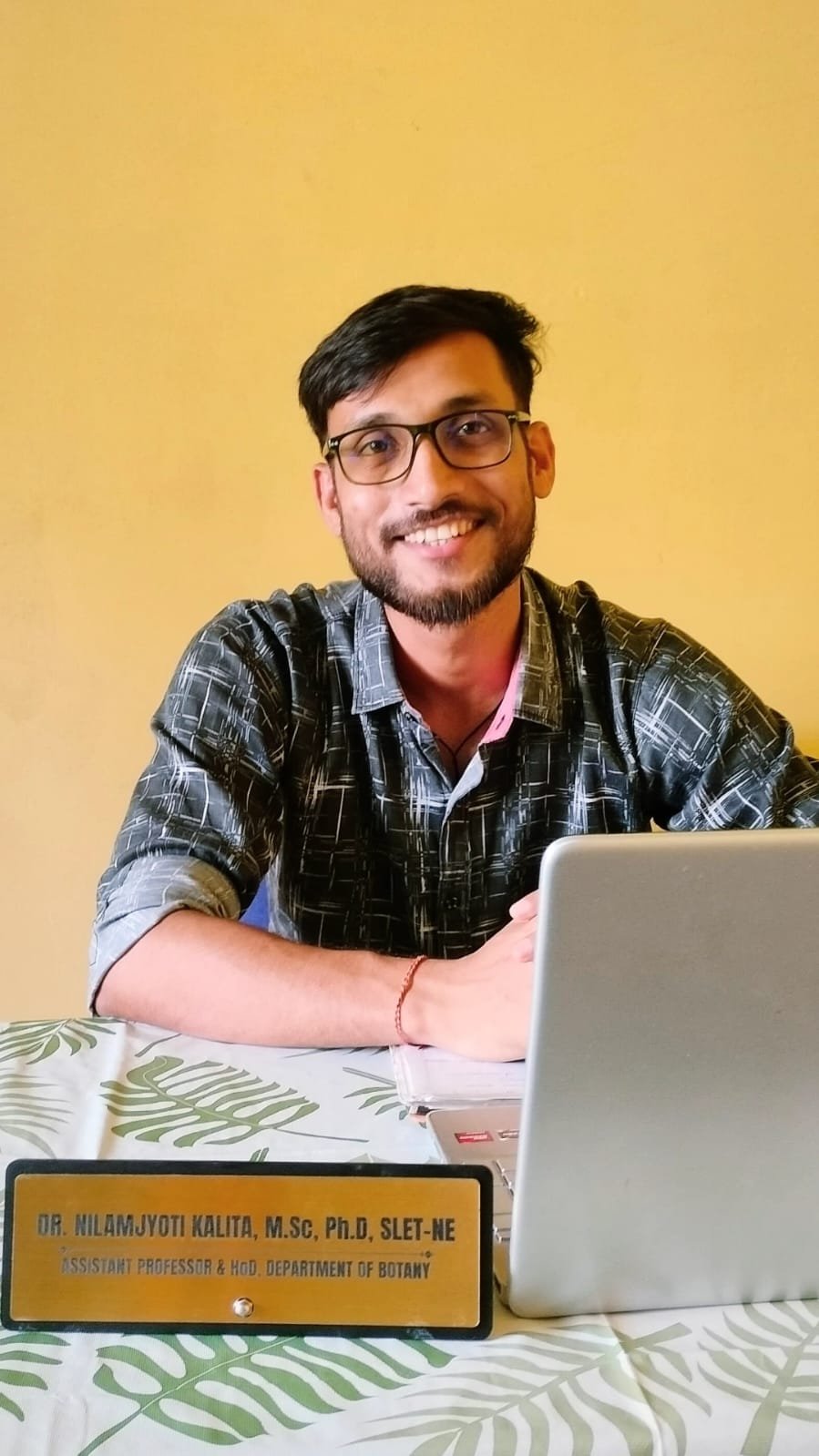
Dr. Nilamjyoti Kalita
Assistant Professor & Head of the Department
Department of Botany
Murkong Selek College
Email: nilamjyotikalita2014@gmail.com
Education
Ph.D.
2020-2025: Ph.D., Department of Botany, Gauhati University. Thesis Title: Heavy metal remediation potentials of some cyanobacterial strains isolated from oil fields of upper Assam.
M.Sc.
2018-2020: M.Sc. in Botany, Department of Botany, Gauhati University.
Specialization: Cytology Genetics and Plant Breeding.
Dissertation: Molecular Techniques Used to Study Bacterial Endophytes in Plants-A Review.
Percentage: 89.5%
B.Sc.
2015-2018: B.Sc. in Botany, Department of Botany, Bajali College.
Percentage: 89%
Professional Experience
Teaching Experience
- Assistant Professor & Head of the Department, Department of Botany, Murkong Selek College, Jonai, Dhemaji, Assam.
Research Experience
- Ph.D. research on heavy metal remediation potentials of cyanobacterial strains isolated from oil fields of upper Assam.
- Research experience in cyanobacterial exopolysaccharides, metal biosorption, microalgal bioremediation, algal taxonomy, stress physiology, and biochemical analysis.
Administrative / Organizational Experience
- Organizational experience in conducting seminars, conclaves, and symposiums.
Research
Research Areas
- Heavy metal biosorption and remediation using cyanobacteria and microalgae.
- Cyanobacterial exopolysaccharides, stress responses, and biochemical analysis.
- Algal taxonomy, including cyanobacteria and green algae.
- Microalgae culture, bioremediation, and phycoremediation.
- Molecular biology techniques including PCR and gel electrophoresis.
- Instrumentation: UV-Vis spectrophotometer, Atomic Absorption Spectrophotometer, FTIR, EDX, Kjeldahl, and bright-field microscopy.
- Herbarium preparation for higher plants and macroalgae.
Research Projects
- Ph.D. thesis: Heavy metal remediation potentials of some cyanobacterial strains isolated from oil fields of upper Assam.
- M.Sc. dissertation: Molecular Techniques Used to Study Bacterial Endophytes in Plants - A Review.
Workshops / Training
- Attended RUSA sponsored Short Term Course on Entrepreneurship Development, organised by UGC-HRDC, Gauhati University, Assam.
- Attended National Workshop on Research Methodology and Scientific Writing, organised by Regional Ayurveda Research Institute, Gangtok, Sikkim.
- Attended Three Day Workshop on Biotechnology: A New Avenue of Research (BCIBTW-2018), organised by Bajali College, Pathsala, Assam.
- Attended Three Day Workshop on Biotechnology: A New Avenue of Research (BCIBTW-2017), organised by Bajali College, Pathsala, Assam.
Awards / Recognition
- Dr. Deba Kumar Bordoloi Memorial Young Scientist Award (BSA) for the year 2026.
- 1st rank holder in M.Sc. Botany, Gauhati University (2020).
- High Quality (Q1) Journal Publication Award, Gauhati University (2026).
- High Quality (Q1) Journal Publication Award, Gauhati University (2025).
- Best Oral Presenter, National Seminar organised by Berhampur University (2024).
- Best Oral Presenter, conclave organised by Gauhati University (2025).
- Desalination and Water Treatment, Elsevier Reviewer Award (May 2024).
- Bioresource Technology, Elsevier Reviewer Award (June 2024).
- Environmental Research, Elsevier Reviewer Award (October 2024).
- Plant Physiology and Biochemistry, Elsevier Reviewer Award (November 2024).
- Discover Nano, Springer Reviewer Award (April 2025).
- Biodegradation, Springer Reviewer Award (April 2025).
- Discover Agriculture, Springer Reviewer Award (April 2025).
- Scientific Reports, Springer Reviewer Award (October 2025).
Fellowships / Scholarships
- Focus Area Science Technology - Summer Fellowship (2019).
- UGC-Ishan Uday for North Eastern Region (2015).
- DHE PG Research Scholarship (M.Phil./Ph.D./LLM), 2021-22.
IT Skills
- Statistical analysis: Student t-test.
- Software: Origin and VOSviewer.
- Microsoft Excel, PowerPoint, and Word.
- Graphical representation: Canva and BioRender.
Publications
Journal Publications
- Kalita, N., Hazarika, P. & Baruah, P. P. (2026). Harnessing cyanobacterial exopolysaccharides for metal biosorption: ultrastructure, stress responses and extraction approaches. Journal of Polymers and the Environment. DOI: 10.1007/s10924-026-03795-6.
- Aktar, S., Bhattacharjee, S., Kalita, N. & Baruah, P. P. (2026). Phytoplankton heterogeneity in jute retting ponds of Brahmaputra-Beki Doab in reference to water quality. Inland Water Biology. Accepted for publication.
- Kalita, N. & Baruah, P. P. (2023). Cyanobacteria as a potent platform for heavy metals biosorption: uptake, responses and removal mechanisms. Journal of Hazardous Materials Advances, 11, 100349. https://doi.org/10.1016/j.hazadv.2023.100349
- Kalita, N. & Baruah, P. P. (2024). Copper removal efficacy and stress tolerance potential of Leptolyngbya sp. GUEco1015. Heliyon, 10(8). DOI: 10.1016/j.heliyon.2024.e29131.
- Dowarah, B., Agarwal, H., Krishnatreya, D. B., Sharma, P. L., Kalita, N. & Agarwala, N. (2021). Evaluation of seed associated endophytic bacteria from tolerant chilli cv. Firingi Jolokia for their biocontrol potential against bacterial wilt disease. Microbiological Research, 248, 126751. https://doi.org/10.1016/j.micres.2021.126751
- Kalita, N. & Baruah, P. P. (2024). Copper removal with chemically reinforced Leptolyngbya sp. GUEco 1015. Desalination and Water Treatment, 320, 100818. https://doi.org/10.1016/j.dwt.2024.100818
- Kalita, N., Boruah, B., Bhattacharjee, S., Kalita, H. & Baruah, P. P. (2025). Exploration of Cyanobacteria in Heavy Metal-Contaminated Water Bodies with Special Reference to Oil Field. Proceedings of the National Academy of Sciences, India Section B: Biological Sciences, 1-9. https://doi.org/10.1007/s40011-024-01662-9
- Teronpi, H., Kalita, N., Baruah, P. P. & Sarma, D. (2025). Microalgae as potent feed ingredient: nutritional and environmental aspects in the current challenge of attaining sustainable aquaculture. Food Bioscience, 107793. https://doi.org/10.1016/j.fbio.2025.107793
- Kundu, B. K., Regon, P., Kalita, N., Borgohain, P., Dutta, A. K., Agarwala, N. & Tanti, B. (2025). Optimized nitrogen supply enhances nitrogen homeostasis, ATP-coupled energy metabolism, and morpho-physiological growth in Keteki Joha rice. Plant Physiology and Biochemistry, 110693. https://doi.org/10.1016/j.plaphy.2025.110693
- Baruah, P. P., Bhattacharjee, S., Kalita, N. & Boruah, B. (2025). A new variety of Chara corallina Willd. (Charophyta: Characeae) from Kamrup District, Assam, India. Journal of Threatened Taxa, 17(8), 27378-27383. https://doi.org/10.11609/jott.9479.17.8.27378-27383
- Baruah, P. P., Kalita, N., Boruah, B., Bhattacharjee, S., Sarma, S. & Kalita, H. (2024). An updated synopsis of genus Chara L. in India. Asian Journal of Conservation Biology, 13(2), 158-170. https://doi.org/10.53562/ajcb.85235
Book Chapters
- Kalita, N., Das, P., Bhattacharjee, S., Chetia, T. & Baruah, P. P. (2025). Pathogenic Algae in Host Microbiota: Invasion Mechanism and Management Strategies. In Plant Microbiome and Biological Control: Emerging Trends and Applications (pp. 337-363). Springer Nature Switzerland. https://doi.org/10.1007/978-3-031-75845-4_15
- Kalita, N., Bhattacharjee, S., Baruah, D., Nath, S. & Baruah, P. P. (2025). Algal Astaxanthin: Genetics, Synthesis, and Advanced Biotechnological Strategies for Therapeutic Uses. In Industrial and Biotechnological Applications of Algae (pp. 137-156). Springer Nature Singapore. https://doi.org/10.1007/978-981-96-1844-6_7
- Kalita, N., Boruah, B., Bhattacharjee, S., Kalita, H., Bora, G. & Baruah, P. P. (2024). Analyzing Copper Dependent Growth Behaviors in Anabaena azollae Strasburger, an Autochthonous Cyanobacterial Species of Assam. In Research Perspectives of Microbiology and Biotechnology, Vol. 1, pp. 43-53. DOI: 10.9734/bpi/rpmab/v1/2890G.
- Kalita, N., Nath, S., Chetia, T., Boruah, B. & Baruah, P. P. (2024). Microalgae: A promising tool for sustainable future. In Futuristic Trends in Biotechnology. e-ISBN: 978-93-6252-330-3.
- Bhattacharjee, S., Kalita, N., Patgiri, S. & Baruah, P. P. (2025). Diversity, bioprospecting and downstream processing of freshwater microalgae: emerging trends in biotechnology. Algae-Derived Biochemicals of Industrial Importance. Springer Nature Switzerland. DOI: 10.1007/978-3-031-85550-4_4.
- Kalita, N., Bhattacharjee, S. & Baruah, P. P. (2026). Miniatured Bioreactor in Microalgae Research for Sustainable Bioprocessing. Miniaturized Bioreactors: Accelerating Industrial Biotechnology. Springer Cham. DOI: 10.1007/978-3-032-22332-6.
- Bhattacharjee, S., Kalita, N., Teronpi, H., Das, P., Dutta, J. & Baruah, P. P. (2026). Comprehensive ecotechnological insights into waste algal biomass for biofuel production: recent advancement and future avenues. CRC Press. Accepted for publication.
Edited Books
- Ahmad, I., Bux, F. & Kalita, N. (Eds.). (2027). Microalgae for Wastewater Treatment and Resource Recovery: Pathways to a Circular Bioeconomy. IGI Global Scientific Publishing. https://doi.org/10.4018/979-8-2600-3080-6
- Ahmad, I., Bux, F. & Kalita, N. (Eds.). (2027). Microalgae for Carbon Sequestration and Wastewater Valorization: Pathways to a Sustainable Bioeconomy. IGI Global Scientific Publishing. https://doi.org/10.4018/979-8-3373-7630-1
Conference Proceedings
- Kalita, N. & Baruah, P. P. (2021). An investigation on biochemical constituents of a few Chara spp. isolated from Deepor Beel Ramsar site and Maguri Beel of Assam. International conference, Cachar College, Silchar, Assam, India.
- Kalita, N. & Baruah, P. P. (2022). Effects of Cu2+ on Anabaena sp. National Seminar, Department of Botany, JN College, Boko, India.
- Kalita, N. & Baruah, P. P. (2022). Analyzing the effects of microelement copper (II) as a stressor in Westiellopsis indica. International conference, Probir Chetterjee Research Foundation, University of Calcutta.
- Kalita, N. & Baruah, P. P. (2022). Investigation on biochemical constituents of few Chara spp. International conference, Department of Botany, PDUAM, Behali, Assam, India.
- Kalita, N. & Baruah, P. P. (2023). Effect of copper induced toxicity on biochemistry of Scytonema sp. and its adsorption potential. 1st Botanical Congress, University of Calcutta, India.
- Kalita, N. & Baruah, P. P. (2023). Leptolyngbya sp. GUEco1015 mediated copper biosorption for making India clean. The National Academy of Sciences (NASI) & Bhabha Atomic Research Centre (BARC), Mumbai.
- Kalita, N. & Baruah, P. P. (2024). Copper biosorption by Leptolyngbya sp. GUEco 1015: growth, biochemistry and chemically pretreated strategies. National Conference, Berhampur University, Berhampur, Odisha.
- Kalita, N. & Baruah, P. P. (2024). Zinc Biosorption Mechanism of Cyanobacterial Strains Isolated from Crude Oil Contaminated Sites of Upper Assam, India. Dibrugarh University, Assam.
- Kalita, N. & Baruah, P. P. (2024). Heavy metal tolerant cyanobacteria isolated from crude oil contaminated waterbodies of Upper Assam. Department of Botany, Gauhati University, Assam.
- Kalita, N. & Baruah, P. P. (2024). Cu2+ Removal efficacy of Scytonema guyanense: Potent cyanobacteria for bioremediation. Department of Botany, University of Science & Technology Meghalaya.
- Kalita, N. & Baruah, P. P. (2025). Exopolysaccharides producing cyanobacteria mediated copper and zinc remediation: a sustainable green technology. Department of Botany, Gauhati University.
- Kalita, N. & Baruah, P. P. (2025). Harnessing cyanobacteria for heavy metal sequestration: physiological role and biosorption mechanisms. Department of Environmental Science, Gauhati University.
- Kalita, N. & Baruah, P. P. (2026). Heavy Metal Tolerant Microalgae as Efficient Biological Systems for the Bioremediation of Metal Pollution. Department of Botany, Mangaldoi College (Autonomous).